The competitor who calls in four minutes beats the better company that calls tomorrow. This is the least glamorous advantage in marketing and the most available.
 Marku Leone · Founder, donebyverde · South Florida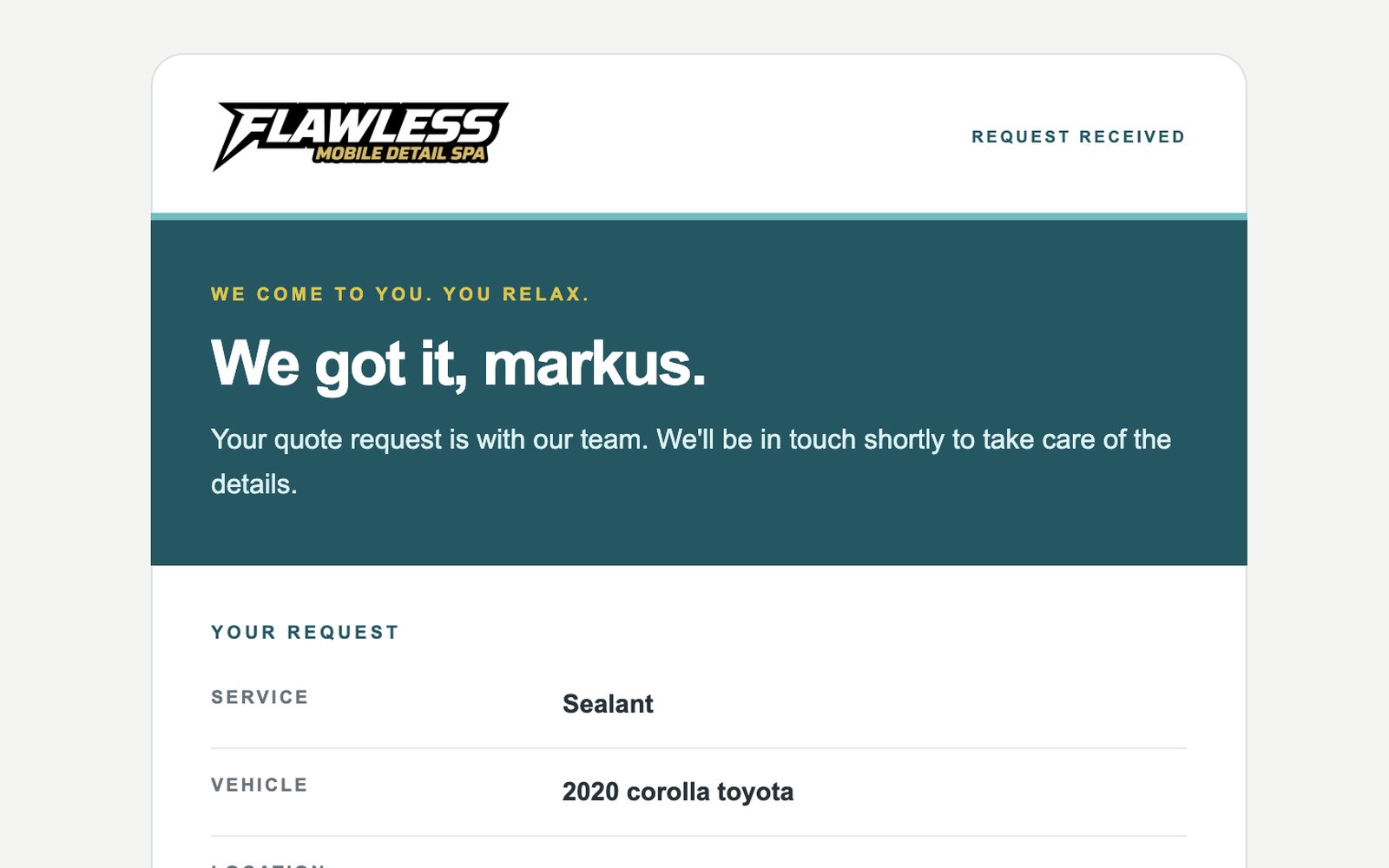
A real auto-reply from a system we built, sent 47 seconds after the form.
A form submission is not a decision. It is a moment of intent, and intent decays fast. The person filling in your form is usually filling in two or three others in the same sitting, they are at their most motivated right now, and every minute that passes makes them slightly less interested and slightly more likely to have already spoken to somebody else.
Research on lead response time has been replicated enough, across enough industries, to be treated as settled in shape if not in exact numbers: contacting a new inbound lead within a few minutes dramatically improves the odds of reaching them and qualifying them, and the curve falls off a cliff within the first hour. By the next day you are not competing for a decision, you are competing for a memory.
The practical consequence is unglamorous. Spending more on ads while taking a day to respond is pouring water into a bucket with a hole in it. Fix the bucket first. It costs nothing and it is usually the single largest available improvement in the whole funnel.
The goal of the first contact is not to sell, qualify, or explain your process. It is to make contact while the person still remembers submitting the form. Everything else can happen later.
So the first touch should be immediate, short and human. A text message beats an email, because it is read in minutes rather than hours. A phone call beats a text if somebody is genuinely available to make it. An automatic confirmation email is not a first touch, it is a receipt, and treating it as contact is how businesses convince themselves they responded when they did not.
What to say is simpler than most people make it. Name yourself and the business, reference the specific thing they asked about so it is obviously not a blast, and ask exactly one easy question. Something close to: "Hi Sarah, it's Marku from donebyverde, you just asked about a new site for the clinic. Quick one so I can point you the right way, are you replacing an existing site or starting from scratch?"
One question. Easy to answer on a phone with one thumb. No pitch, no calendar link, no paragraph about your process. The only objective is a reply, because a reply turns a lead into a conversation and conversations are where the work actually happens.
Most leads will not reply to the first message, and this is where the majority of businesses quietly give up. Two attempts and silence is the norm, which is exactly why persistence works: you are not competing against the ideal follow up, you are competing against everybody else stopping.
A cadence that holds up in practice looks roughly like this. Text within five minutes. Call within the hour. A short email the same afternoon with something genuinely useful attached, a relevant example of your work or a straight answer to the question they asked. Call again the following morning, because morning and evening reach different people. Then a text on day three, an email on day five, and one final message somewhere around day ten or fourteen that plainly says you are closing the file.
Six or seven touches over two weeks. That is more than most businesses do and considerably less than a sales sequence that annoys people, and the difference between those two things is content rather than count.
The line is whether each message carries something new. "Just checking in" and "circling back" carry nothing, they are the sound of someone with a quota, and every additional one lowers your standing.
Compare that to a message that says: "Sarah, here's the clinic site I mentioned, it's the closest thing we've built to what you described and it books about forty appointments a month. Worth twenty minutes?" That is a fourth touch that a reasonable person is glad to receive, because it moved something forward.
The final message matters more than people expect. Saying plainly that you are going to stop, without guilt or theatre, is the most replied to message in most sequences. It is honest, it removes the obligation to respond, and it frequently gets one anyway.
Automation should guarantee that the first touch happens in seconds and that no lead is ever silently dropped. It should not write the conversation. The moment your follow up reads like software, you have traded the advantage you were trying to buy.
The sensible split: automate the instant acknowledgment, the internal alert to whoever is responsible, the task reminders for each touch in the cadence, and the tracking. Keep the actual words human, or at minimum human reviewed. A templated first line with a genuinely specific second line beats a fully personalised message that arrives a day late, and it also beats a fully automated one that arrives in four seconds and sounds like it.
Median time to first touch, measured in minutes rather than hours, and measured from form submission rather than from when someone noticed. Contact rate, the share of leads you actually reach with a two way exchange. Set rate, the share of contacted leads that book something.
Those three numbers will tell you where the problem is with no ambiguity. Slow time to first touch is an operations problem. Good speed with a poor contact rate is a channel problem, you are reaching people the wrong way. Good contact rate with a poor set rate is a message or a fit problem, and that is the only one of the three that is actually about sales skill.
Almost every business that believes it has a lead quality problem discovers, on measuring this, that it has a response time problem instead.
Founder of donebyverde, a studio in South Florida. We build the site, shoot the content, and wire the follow up that answers first, for service businesses across South Florida. This article is how we actually work.
Talk it throughReal partnerships start with one strategy call.
Get It Done